

Japanese study guide
Cotobara's Grammar Lessons: How the Course Works
How Cotobara teaches Japanese grammar, from the 38-chapter N5 course to the lesson steps, the sentence builder, and why each chapter opens only once you know its words.
Vocabulary tells you what the words are. Grammar tells you how they fit together: which particle marks what, how a verb changes shape, and why the same three words can mean different things in a different order.
Cotobara's grammar course sits under Study → Grammar. This post covers how it is organised, what a lesson looks like, and how it connects to your vocabulary.
A course, not a reference list
Grammar is taught as a path of short chapters, one after another, in the order they build on each other. The N5 course has 38 chapters, from how Japanese writing works and your first です sentence through particles, the て-form, plain forms, giving and receiving, and polite and humble speech, ending with a chapter that brings them all together. Most chapters take four to nine minutes.
The next chapter is always at the top of the path, marked Up next, and a progress bar shows how much of the level you have finished. Chapters for N4 to N1 are written and open as each one completes review by native speakers; levels with chapters still in progress are marked as such.
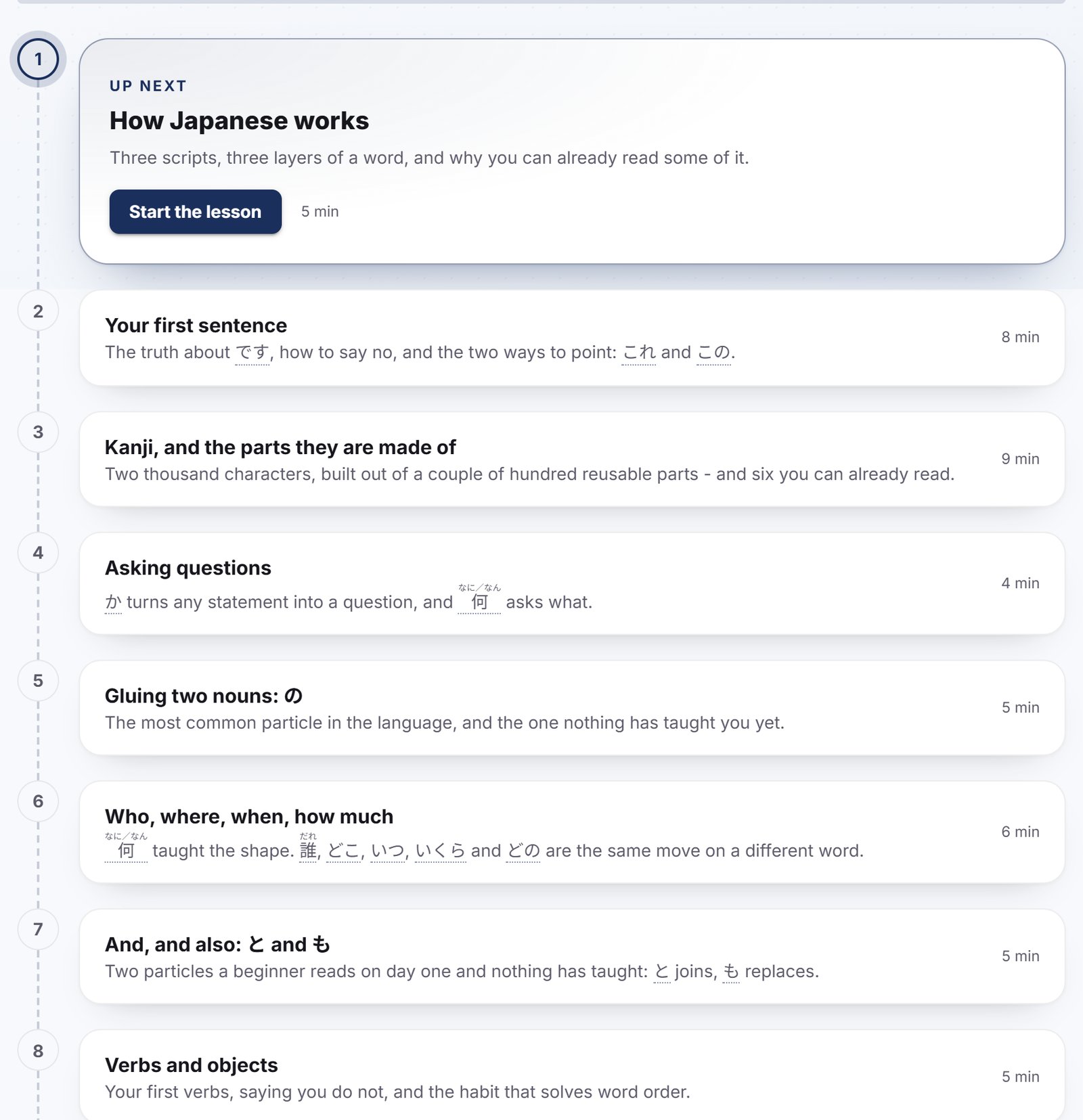
Chapters open when you know their words
Every chapter is written using words from Cotobara's vocabulary, and it opens once you have learned those words. The example sentences are made of words you have already studied, so your attention goes to the grammar.
- N5 chapters open with your Cotobara level. A locked chapter shows the level it needs, for example "Level 12".
- N4 to N1 chapters open once you have learned enough of the words for that band. A locked chapter tells you how many are left, for example "123 N4 words to go". You do not need every word; around 80% of the band is enough for the chapters that use its later words.
- Words you skip as already known count too, on Premium, so you are not held back by words you learned elsewhere.
You do not need to keep track of this. Keep doing your vocabulary lessons and the next chapter opens by itself. The lessons are free, but the new words that open later chapters come with Premium.
Inside a lesson
A lesson is a series of short steps, with a progress bar at the top. Each step asks you to do something before you continue, so you cannot skim through it.
1. Guess first
Each lesson starts with a question you have not been taught to answer: "No explanation yet. Commit to an answer, then find out." There is no penalty for a wrong guess. Committing to an answer first makes the explanation that follows easier to remember, whether your guess was right or wrong.
2. The pattern
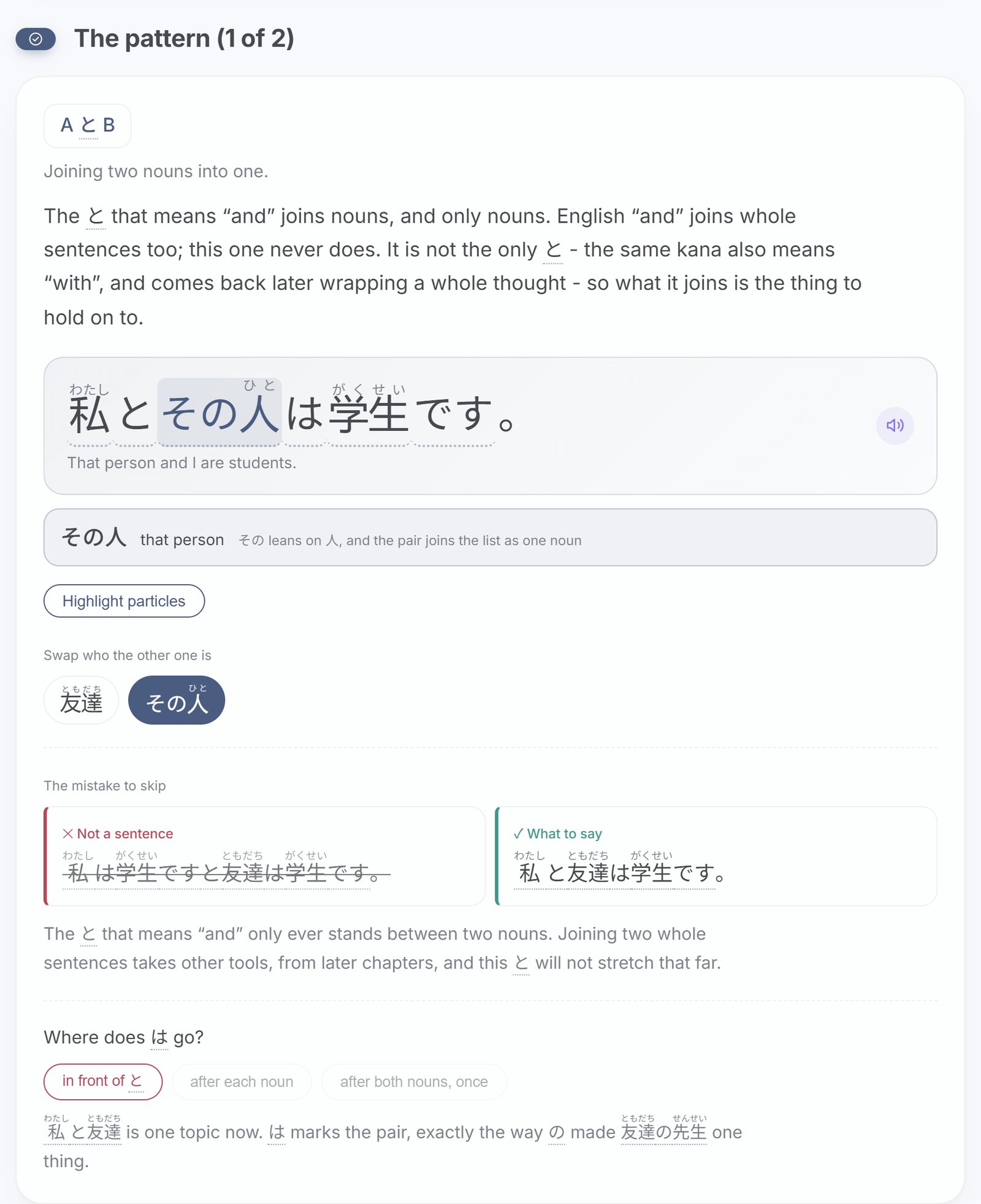
Each grammar point gets its own card. The card shows the pattern, a short explanation, and an example sentence with furigana over every kanji. Tap any word in the sentence for its reading and meaning, press the speaker to hear it read aloud, and use Highlight particles to show how the sentence is held together.
Many cards let you swap one word in the sentence to see what changes and what stays fixed. The mistake to skip puts a common learner error beside what a Japanese speaker would actually say, with a sentence on why. A short check question at the end of the card confirms you have understood it.
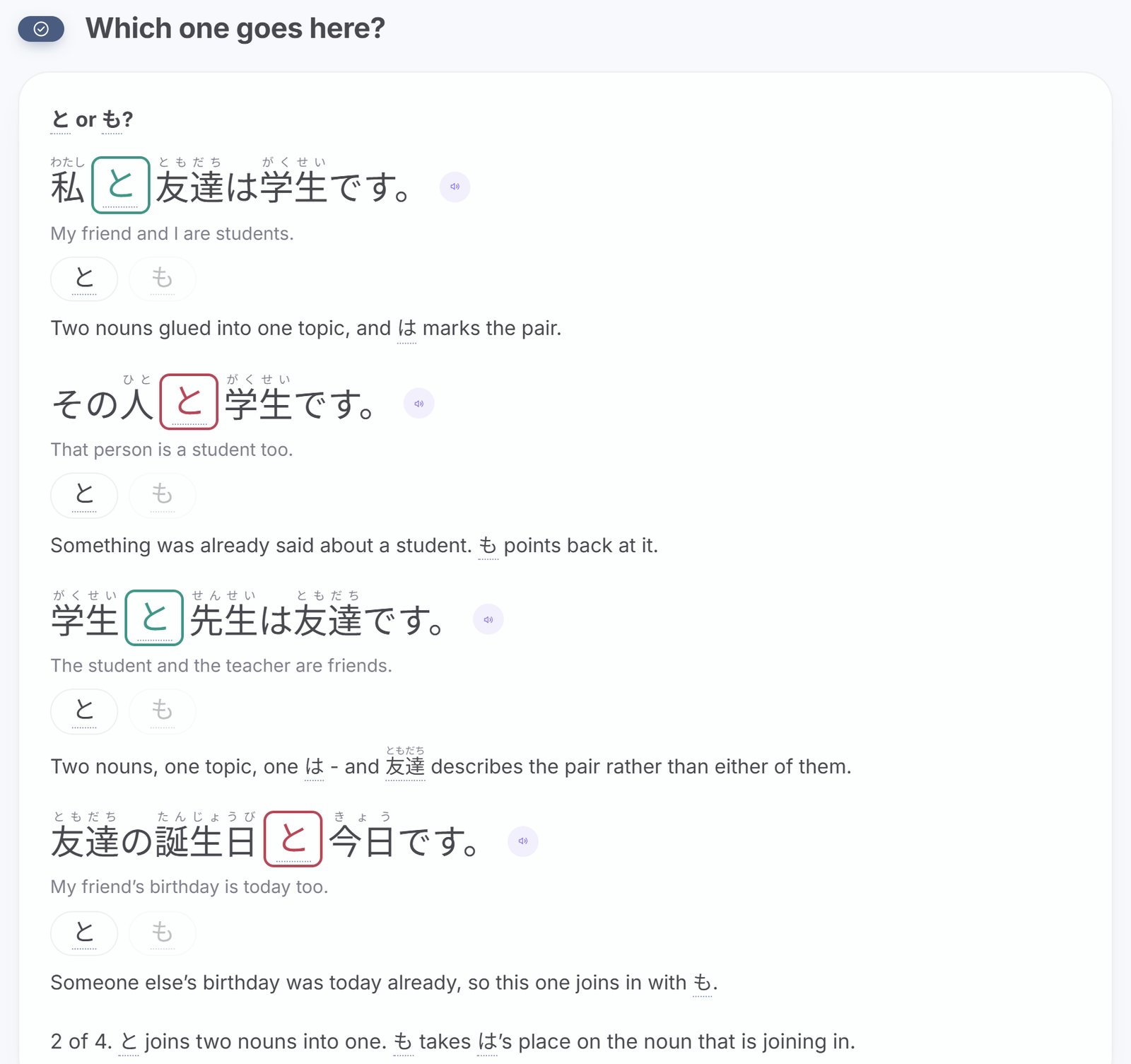
3. Which one goes here?
Next, you fill in gaps in sentences. Each item is a sentence with one piece missing, often a particle, and two to five options. Once you answer, the lesson explains why that option is right, so a wrong answer still teaches you the rule. Chapters that cover two easily confused patterns add a second round to tell them apart.
4. In a conversation (N4 and later)
From N4, chapters add a short exchange where you pick the reply that fits, so you see the pattern in a conversation, not just in a single sentence.
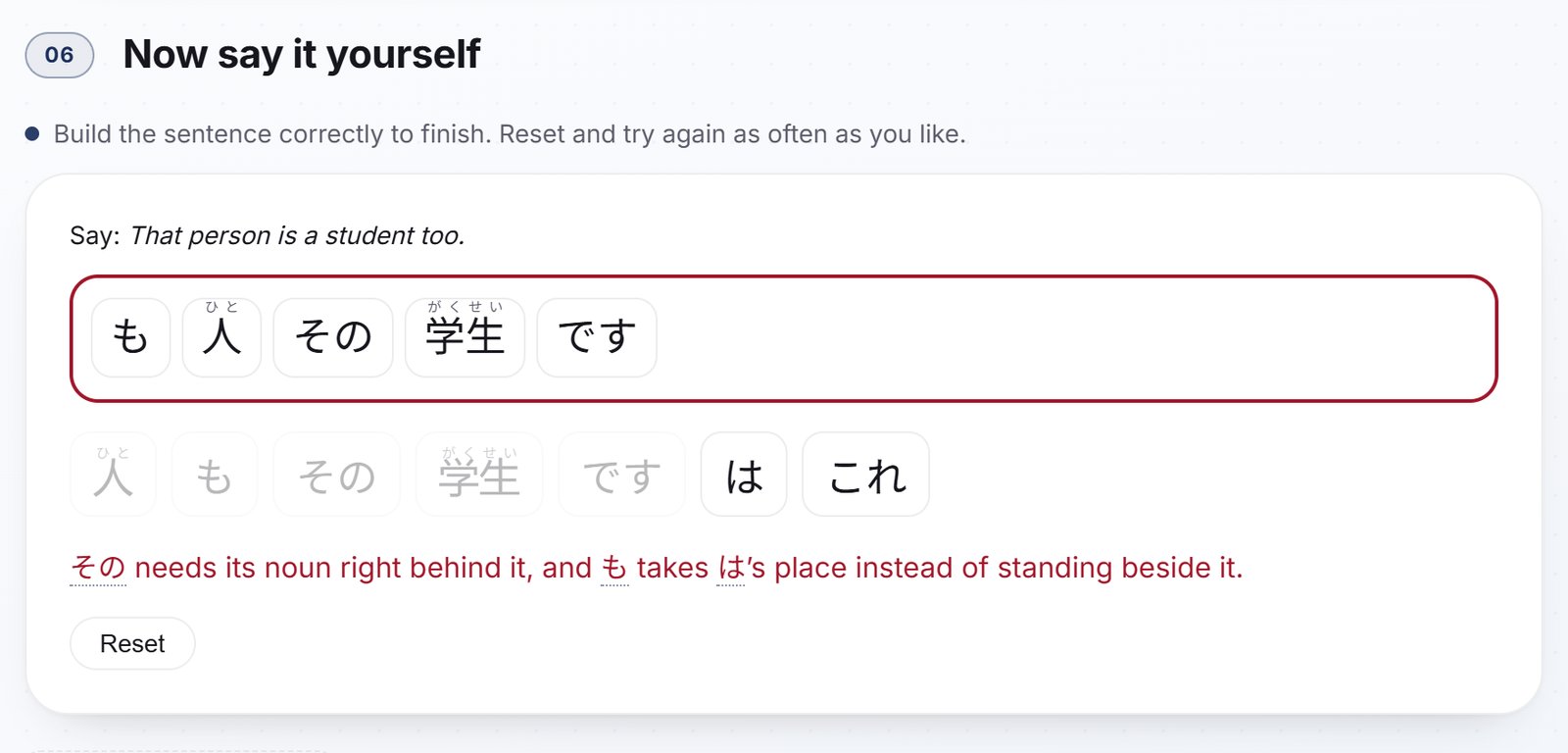
5. Now say it yourself
The lesson ends with building a sentence from an English prompt. You tap the pieces into order, and the tray includes a few pieces that do not belong. A wrong order gets a specific explanation rather than just a red mark, and you can reset and try again as often as you like.
Chapters on conjugation follow the same idea with a different middle: a table of the rule for each verb group, then practice building each form before you use it in a sentence.
Every example sentence has audio, in a male or female voice depending on your settings.
After the lesson
The final screen suggests saying the sentences out loud once before you go, and offers the next chapter if it is open.
Practice with AI gives you more practice on the chapter. It opens ChatGPT or Claude, in your own account, with a prompt that sets out the chapter's grammar and words. The chatbot gives you sentences to translate into Japanese one at a time, gives small hints if you ask, corrects each answer, and every few sentences tells you what you keep getting wrong. The button is also on every chapter you have finished, so you can come back to a pattern weeks later.
Grammar points do not go into your review queue. What you review is vocabulary, and grammar is practised each time you read or use those words in sentences. If you need a refresher, open a finished chapter again at any time.
Use it with people
The grammar page itself starts with a reminder: a language exists for talking to people. The lessons can help you understand how a sentence is put together, but you learn to use it by saying it to someone, whether a tutor, a class or a language exchange, and being corrected. Use the course to understand each pattern, then try the sentences on a person.
The course is also available in Vietnamese, Spanish, French, Indonesian and Portuguese, using the language you chose for Cotobara.
For an overview of what the first level covers, see the JLPT N5 grammar list, and for the particles in more depth, the Japanese particles guide.