

Japanese study guide
Cotobara's Kanji Lessons: Readings, Radicals and Writing
How Cotobara teaches the 2,136 jōyō kanji alongside your vocabulary, with readings taught through real words, radicals, stroke order, optional handwriting, and spaced-repetition reviews.
Cotobara has always taught kanji through the words that use them. Kanji lessons add the characters themselves: what each one means, how it is read, what it is built from, and, if you want, how to write it. They run in the same queue as your vocabulary, so a kanji and the words that contain it reinforce each other.
This post covers the kanji pages, how to turn lessons on, what a lesson and a review look like, and how to set a sensible pace.
All 2,136 jōyō kanji, by JLPT level
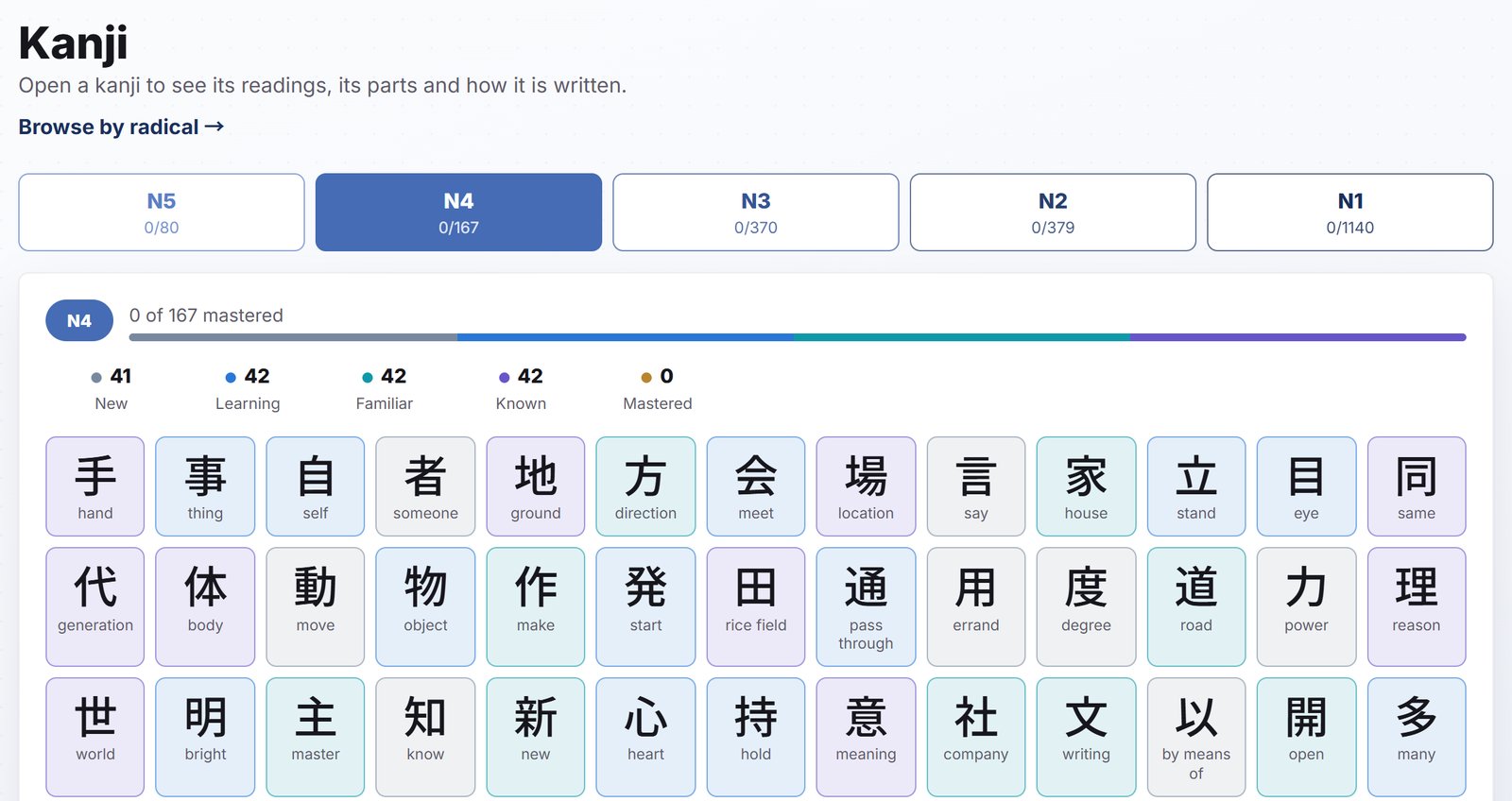
Open Study → Kanji to see every kanji grouped by JLPT level. Within each level, kanji are ordered so the most widely used come first. Cotobara's own split is 80 at N5, 167 at N4, 370 at N3, 379 at N2 and 1,140 at N1.
Each tile shows the kanji and its main meaning, coloured by how far along you are, and a bar at the top counts your kanji at each stage: New, Learning, Familiar, Known and Mastered.
The kanji page
Open any kanji for its full page:
- Readings: on'yomi and kun'yomi.
- Radicals: the parts it is built from, each linked to its own page.
- Stroke order: every stroke, numbered, one frame at a time.
- Write it: a pad to trace the kanji yourself.
- Words with this kanji: the vocabulary that uses it, linked to each word's page.
- Used in: larger kanji that contain this one.
- Similar looking kanji: the characters most easily confused with it, such as 未 and 末.
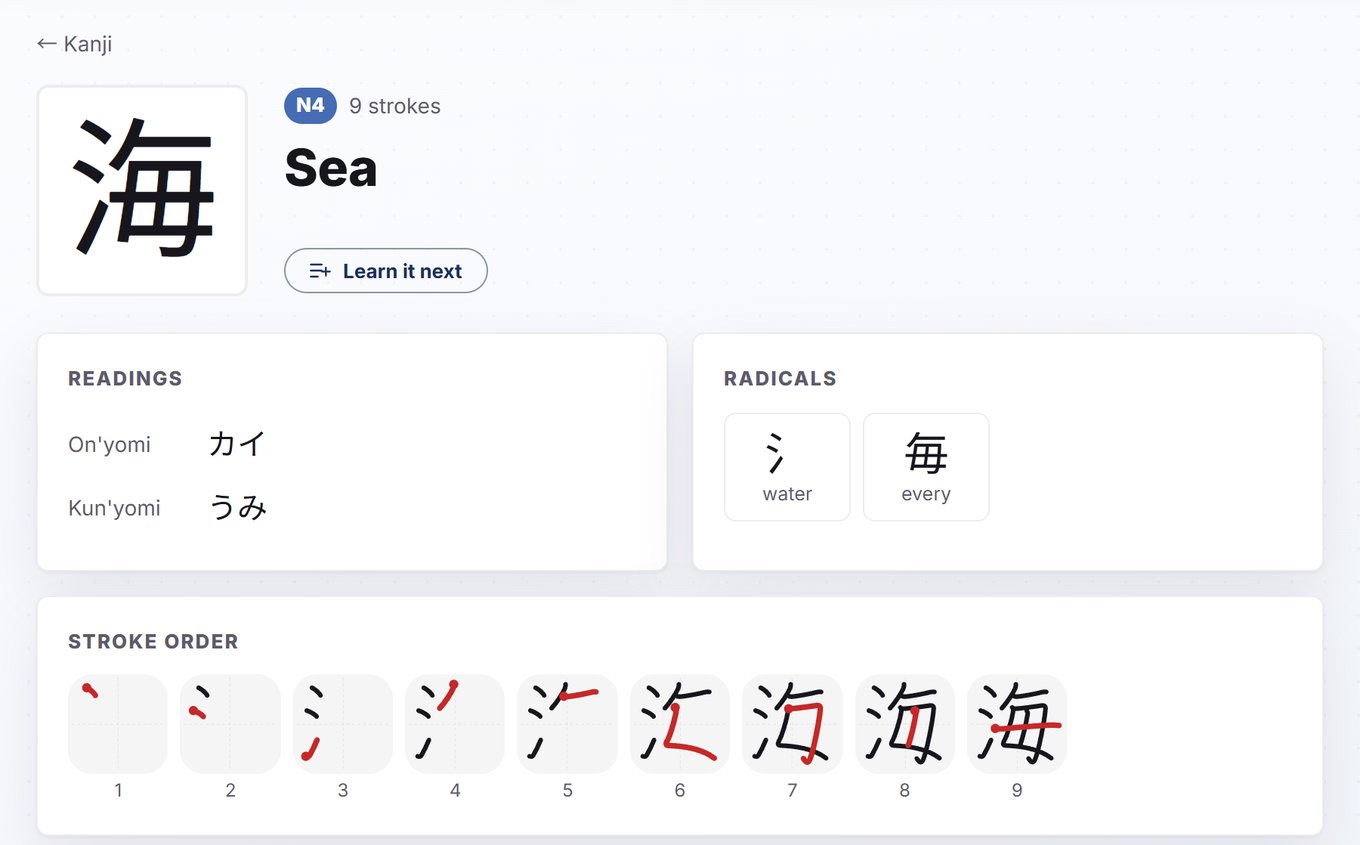
Kanji pages and radical pages are free to browse. Learn it next puts a kanji at the front of your lessons. If you already know a kanji well, Mark as familiar skips the early reviews and checks it once a few days later; Mark as skipped takes it out of your lessons and reviews completely.
Radicals
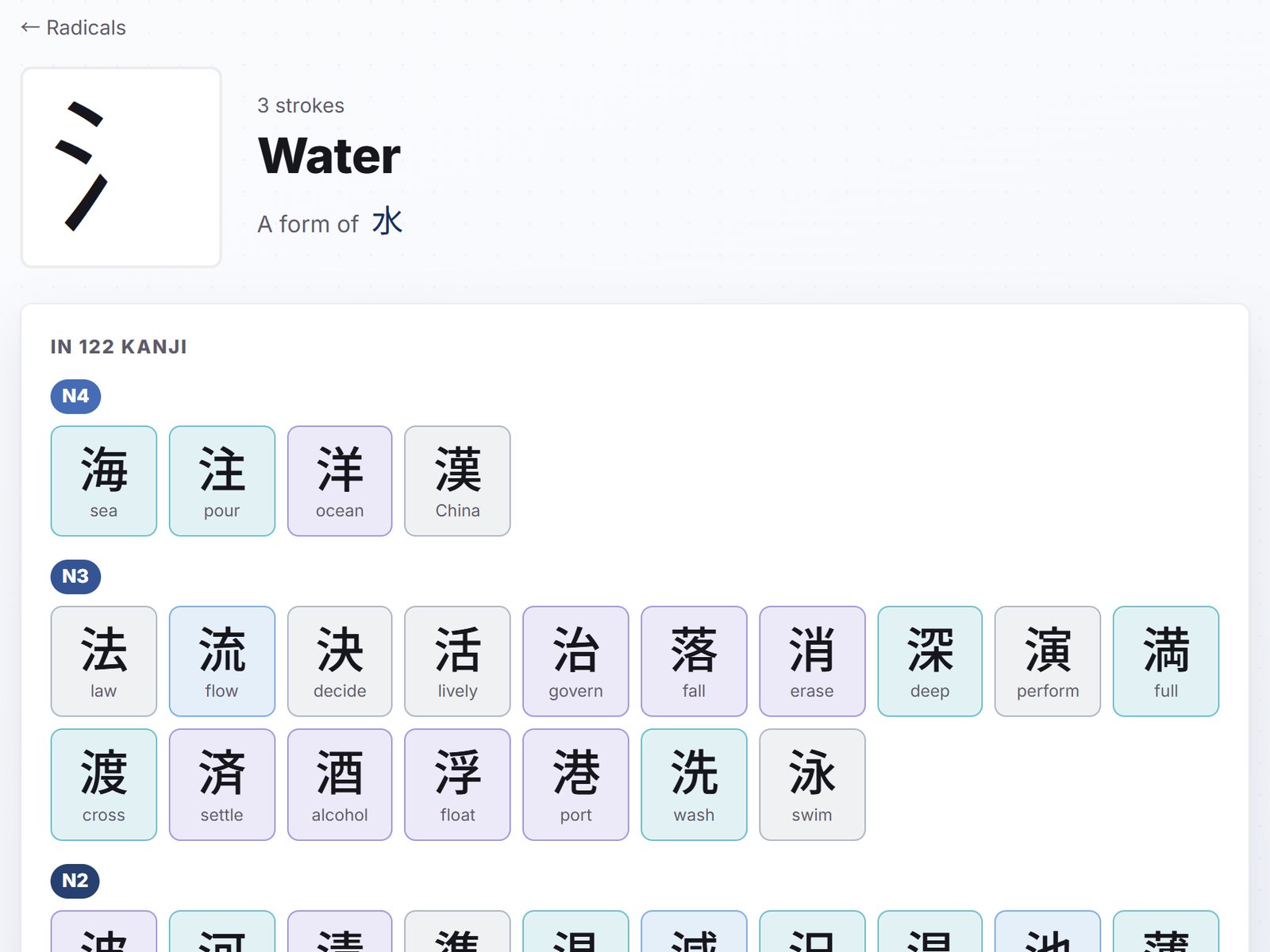
Browse by radical lists the 344 building blocks that kanji are made from, grouped by stroke count. Open one to see every kanji that contains it, sorted by level. Learning to see 氵 as "water" makes 海, 港, 湖 and dozens of others easier to remember: each new kanji becomes a combination of parts you already know.
Turning kanji lessons on
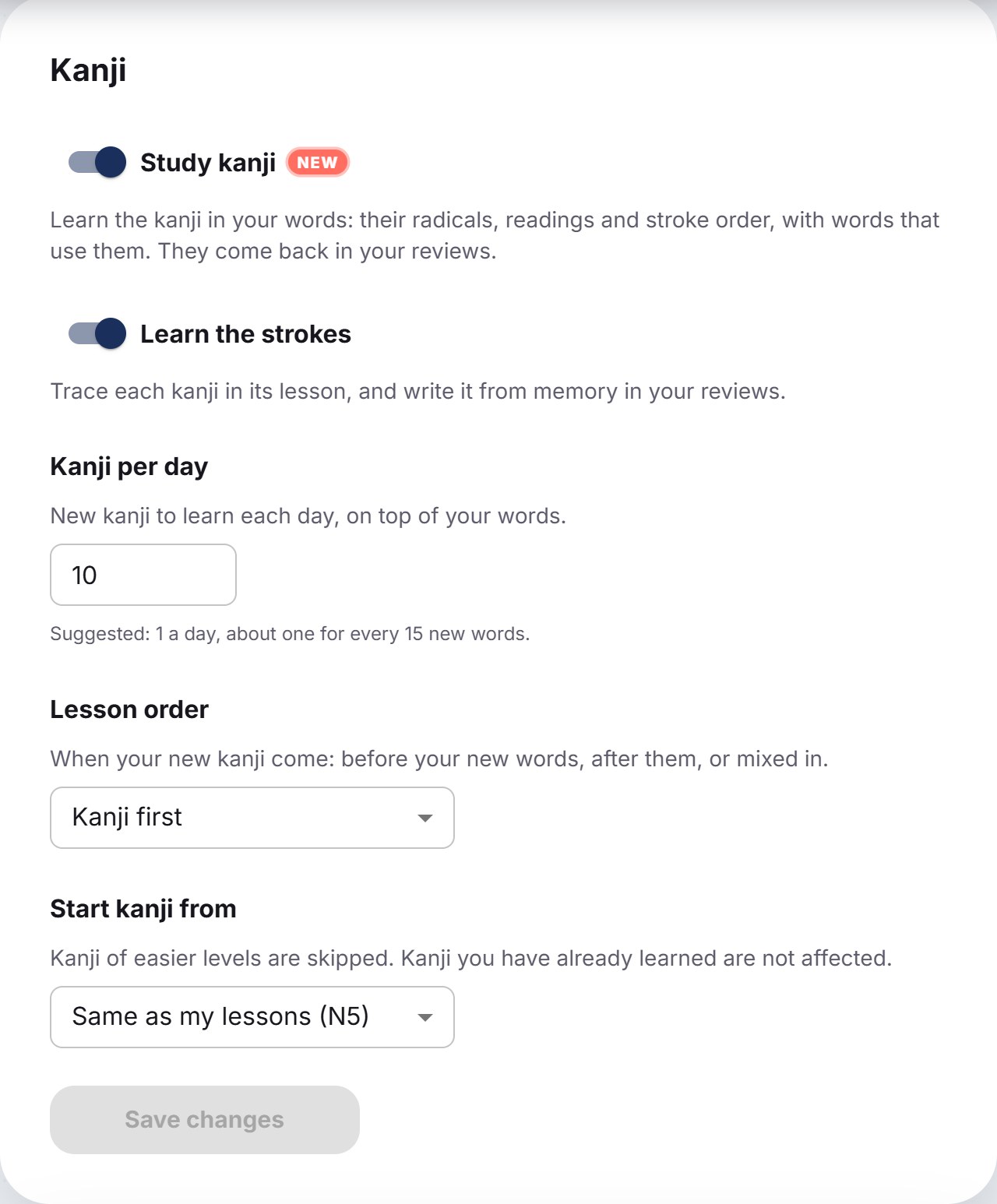
Kanji lessons are off until you switch them on in Settings → Kanji:
- Study kanji adds kanji to your lessons and reviews.
- Learn the strokes adds tracing to each lesson and writing from memory to your reviews. It is off by default; see below.
- Kanji per day sets how many new kanji you learn each day, on top of your words. The suggestion is about one kanji for every 15 new words.
- Lesson order sets whether kanji come before your words, after them, or mixed in.
- Start kanji from lets you skip the levels you already know.
You can also choose these when you sign up. Kanji lessons and reviews are part of Premium: the trial teaches up to 3 a day, and Premium up to 10.
Inside a kanji lesson
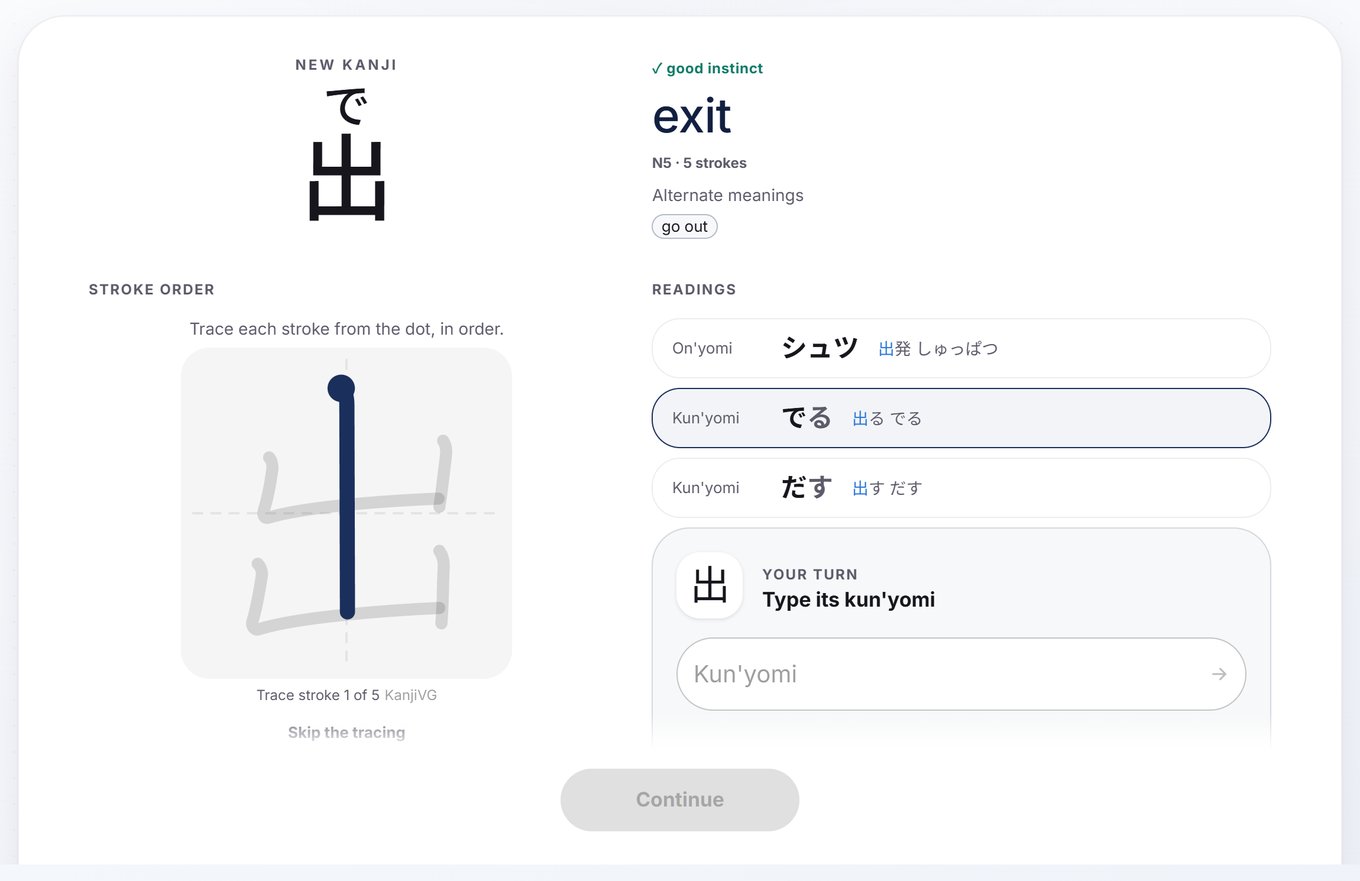
Each new kanji starts with a guess: the kanji on its own and four possible meanings. The wrong options are other kanji that share a part or a level, so you have to look closely. There is no penalty for a wrong guess.
Then the lesson shows the kanji in full:
- Stroke order, as an animation, or a tracing pad if Learn the strokes is on.
- Readings, each one shown with a real word that uses it. One of them is outlined: the reading you will be asked for in reviews, taken from the kanji's most common word.
- Your turn: you type that reading straight away. Mistakes are corrected on the spot.
- Parts, Similar looking kanji and Words, for context.
Continue stays disabled until you have typed the reading correctly and, with strokes on, traced the kanji or chosen Skip the tracing. A short meaning check follows later in the lesson.
Kanji reviews
Learned kanji come back in your normal review session, mixed with your words, on the same spaced-repetition schedule: the first review a few hours after the lesson, then at longer intervals as you get it right. Each kanji is reviewed as two cards:
- Meaning: "What does this kanji mean?" Early on you choose from four look-alike meanings; after that you type it.
- Reading: type the reading you learned. If you type a different valid reading, Cotobara tells you and asks for the one you learned, instead of marking it wrong.
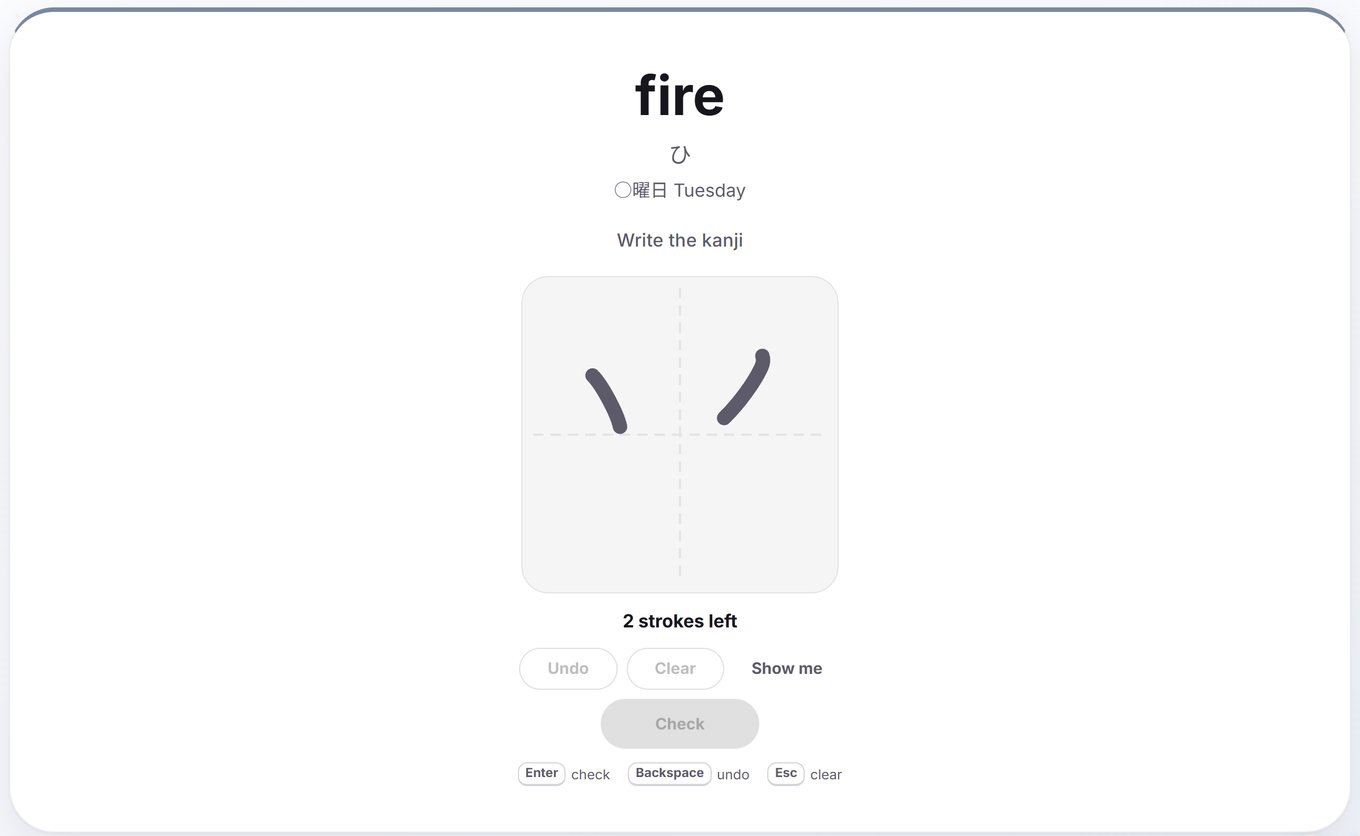
With Learn the strokes on, a third card asks you to write the kanji from its meaning, its reading and a word with the kanji left blank. While a kanji is new, half its strokes are drawn in for you, then a quarter, then none. Grading allows for differences in size and position, accepts two strokes written in swapped order, and lets one stroke be off.
Should you learn to write?
For most learners, not at first. Reading kanji is what you need for reading Japanese and for the JLPT, which does not test handwriting. Writing every kanji from memory adds a third review card to each one. That is why Learn the strokes is off by default.
Turn it on if you are taking a class that tests writing, if you plan to live in Japan and fill out forms by hand, or if writing a character helps you remember it. Stroke order is shown in every lesson either way, and it helps you to recognise a kanji even if you never write one.
A sensible pace
Kanji and words share one review queue, so every new kanji adds future reviews, just as a new word does. A few guidelines:
- Start with the suggestion. About one kanji for every 15 new words keeps kanji in step with your vocabulary.
- Words come first. If reviews start piling up, reduce kanji per day before you reduce new words.
- Skip what you know. If you have studied kanji elsewhere, set Start kanji from to your level instead of starting again at N5.
For the wider picture on studying kanji, see the best way to learn kanji and how many kanji you need.
Kanji data, including stroke order from KanjiVG, is used under the licences credited on our About page.